Navigate to...
Civil Society Organisations in Sport (MOS) present to House of Representatives
Social sports and exercise organisations are taking up the challenge to encourage vulnerable Dutch people to exercise and participate in sports more. MOS contributes to a society where everyone can experience the pleasure and benefits of sports and exercise.
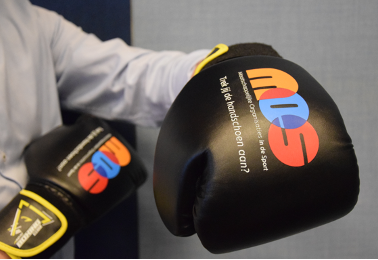
Social sports and exercise organisations are taking up the challenge to encourage vulnerable Dutch citizens to exercise and participate in sports more. MOS contributes to a society where everyone can experience the pleasure and benefits of sports and exercise. The challenge was shared today with the House of Representatives delegation with the message “take up the challenge and join the fight” for equal access to sports and exercise. Well-known athletes and role models were present and challenged the members of the House of Representatives to enable more vulnerable Dutch citizens to participate in sports and exercise.
MOS points out that the current situation is at odds with the government's ambition.
Erosion in social cohesion is leading to increased inactivity among vulnerable people. The decline in sports and exercise, the shift of organised sports to peripheral areas and the resulting decline in local connections between sports and citizens go hand in hand with an increase in social issues and challenges. This unprecedented combination of circumstances is leading to a decline in collective health in the Netherlands, while physical inactivity is on the rise. This development is at odds with the government's ambition to achieve 75% participation in sport and exercise by 2040.
MOS endorses that the importance of sport and exercise is supported by society.
in sport, education and work. Investing in sport and exercise translates into a healthy, energetic and happy society. Everyone benefits from this because every euro invested in sport has an ROI of 2.7 (Rebel/KCSB 2022).
MOS gives the sports and exercise sector a social boost
MOS addresses areas that are not adequately covered by organised sport. It works on the principle of moving from inactive to active, based on self-management. With insight and overview of the barriers and needs, policy is developed with effective interventions and practical solutions. This ensures that MOS is active precisely where the organised sports and exercise sector does not or insufficiently provide for these needs. MOS offers alternatives for all vulnerable groups that are desperately needed in that environment.
MOS's three goals for 2030:
MOS utilises its knowledge, expertise and organisational strength to achieve the following:
1. Equal participation in sport and a culture of sport with equal opportunities for all
2. The connection for a professional and financially sound sports sector
3. Increasing the social value of sport and exercise
The first two urgent issues that MOS is putting on the agenda are:;
The Sports Act
MOS supports the creation of a sports law because it believes that vulnerable groups are structurally excluded. By explicitly mentioning vulnerable groups in the sports law, we ensure that these groups are structurally included in future sports policy.
Community sports coaches
MOS believes that more capacity is needed for the deployment of community sports coaches. Close to home, so that vulnerable groups can be better reached and encouraged to participate in sports and exercise on a regular basis.